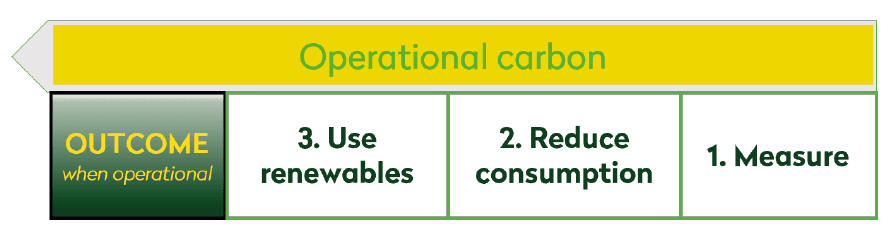
Reducing a building’s operational carbon emissions means improving its energy efficiency, and then using on-site renewables to meet its remaining energy requirement
Operational carbon refers to the greenhouse gas emissions generated primarily from a building’s energy consumption while it is ‘in use’ – including those from heating, hot water, cooling, ventilation, lighting, cooking, equipment, lifts, and additional loads such as electric vehicle charging points and servers.
Currently, there are two metrics that can be used to demonstrate a building’s operational alignment with Science-Based Targets:
Energy use intensity (EUI): EUI measures annual energy use relative to the associated floor area (expressed in kWh/m²/yr). This can vary significantly depending on the building type/ tenant; for example, data centres and hospitals will consume substantially more energy than office buildings. (For that reason, our Spectrum stipulates that only occupied buildings with actual usage data over a full calendar year can be classified as ‘True Zero in Operation’.)
Carbon intensity: This shows the greenhouse gas emissions associated with that energy use (expressed in kgCO2e/m²/yr). It is calculated by multiplying the EUI by the relevant ‘emissions factor’ – a coefficient that represents the carbon footprint of the energy sources used to power the building. So if we use lower-carbon energy sources (e.g. on-site solar or wind), the emissions factor – and therefore the carbon intensity – is lower.
These figures can then be benchmarked against sector- and region-specific 1.5°C pathways using a tool like CRREM (the Carbon Risk Real Estate Monitor).
Although CRREM allows building owners to demonstrate alignment with SBTs using either metric, it now recommends disclosing both. We have chosen to adopt this approach, as it gives a more complete picture of alignment.
Reducing energy use intensity should be the first priority – because this metric relates solely to the building, and is therefore the area where building owners have the most influence and control. Whatever the building use, owners can have a substantial impact on reducing current or future energy consumption, either through building optimisation and tenant engagement (for existing assets) or through smart design choices (for new developments or retrofits). This also adds value by making the building more resilient and cheaper to operate.
But if our goal is to reduce emissions, we ultimately need to focus on carbon intensity. Reducing energy use intensity as far as possible is the first aspect of this; the other is ensuring that the remaining energy demand is met by lower-carbon energy sources (not fossil fuels). As the grid decarbonises, access to cleaner energy has been getting easier. But for a building, the most reliable and resilient way of securing clean energy is by maximising the use of on-site renewables, which are becoming increasingly cost-effective.
We look at some of these possible actions in the following pages.