Reducing embodied carbon remains challenging; but it is essential if we are to achieve True Zero
To date, most of the focus on reducing emissions from the built environment has been on operational emissions. But due to improvements in energy efficiency and the increasing use of clean energy to power the grid, operational emissions are trending downwards. That means embodied carbon – the emissions associated with the materials, construction, maintenance and eventual disposal of a building – are starting to account for the majority of a building’s whole-life carbon emissions. This is likely to result in greater incentives and regulatory pressures (e.g. the Energy Performance of Buildings Directive, which requires EU member states to set whole-life carbon targets by 2027).
Embodied carbon broadly falls into three areas. The first, and by far the most significant, is the ‘upfront’ carbon emitted during the construction of the building – from the extraction and processing of raw materials, to their transportation to the site, to the building process itself. The second area is the carbon emitted from maintenance and major refurbishments during the building’s ‘in use’ phase. Then the third area is the carbon emitted when the building reaches the end of its life: the demolition process and the disposal of materials.
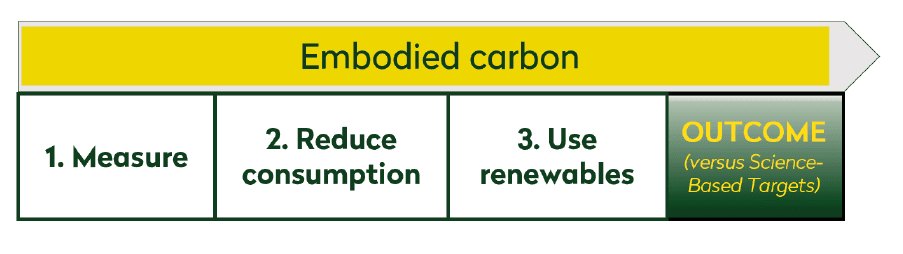
In the Spectrum, we focus primarily on the first of these elements: upfront carbon. This is both the largest element of embodied carbon, and also the easiest for investors to influence. With our Spectrum, we look to measure or model the upfront carbon intensity of our assets, and then classify each one based on how this compares with the relevant Science-Based Target.
To reduce embodied carbon meaningfully, there are four key challenges to address (box, right). These largely come down to the materials we use, and the construction process itself. We look at how to tackle these challenges in the following pages.
The lack of low carbon alternatives for some common building materials
The cost/ availability of those alternatives that do exist
A lack of established ‘carbon optioneering’ practices for comparing the carbon impact of different construction options
The feasibility of using renewable energy across the entire production and construction supply chain and on the building site