Appendices
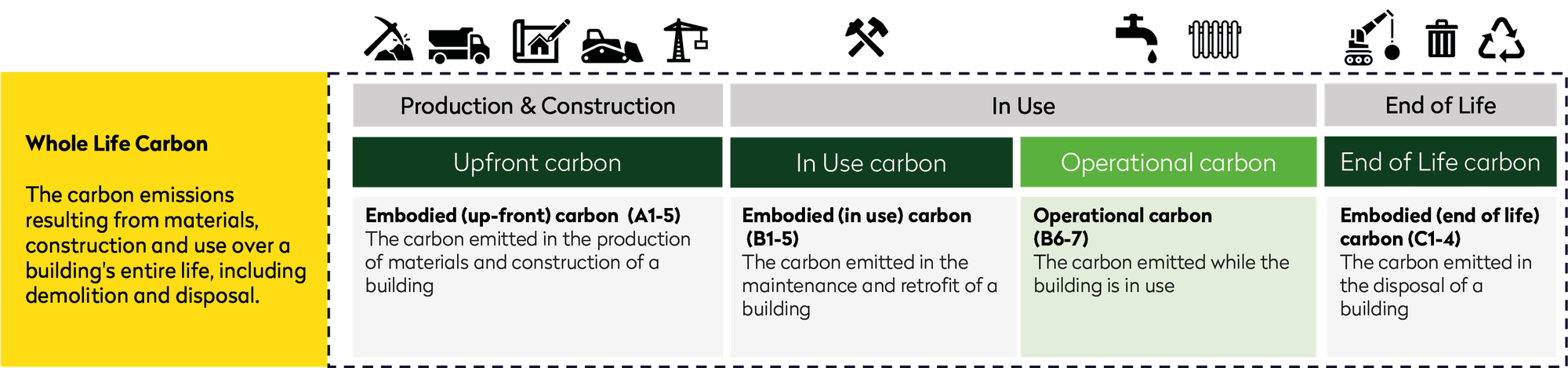
To analyse a building’s impact, we must consider both its operational and embodied carbon emissions
OPERATIONAL CARBONOperational carbon impacts result from energy (B6) and water consumption (B7) during the ‘In Use’ phase of a building.
EMBODIED CARBONEmbodied carbon impacts arise from sourcing, manufacturing and supplying the materials required (the ‘Production’ phase); the actual building of the asset (‘Construction’), any maintenance, repair and refurbishment during the ‘In Use’ phase; and ultimately the asset’s demolition or deconstruction, along with waste treatment and disposal (‘End of Life’).
N.B. Within embodied carbon, this Spectrum primarily focuses on ‘Upfront carbon’ (A1-A5), both because this is the most significant source of embodied carbon, and because there are science-based targets and benchmarks available.
APPENDIX B: SCOPE 1, 2 AND 3 OPERATIONAL EMISSIONS
For accounting and reporting, greenhouse gas (GHG) emissions are categorised into three scopes
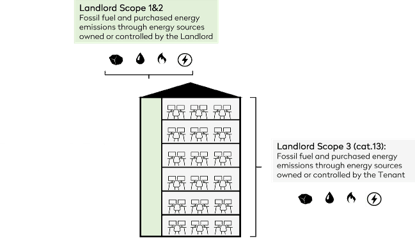
According to the GHG Protocol, for landlords (which is often the investor), scopes 1, 2 and 3 are classified as:
Scope 1: Emissions from sources owned or controlled by the landlord, such as on-site fuel combustion
Scope 2: Emissions from purchased electricity, heating, or cooling in areas owned or controlled by the landlord
Scope 3: Cat.13: Emissions from the tenant spaces if not included in Scope 1 and 2.