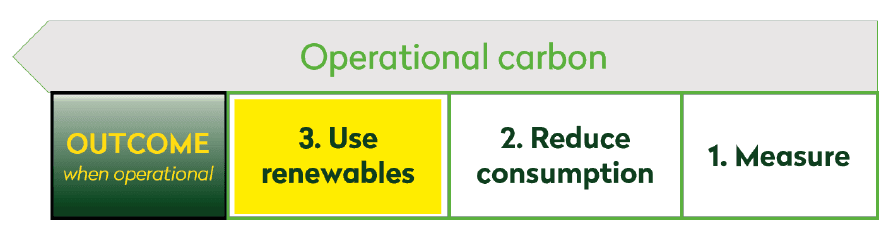
3. Use Renewables (Operational Carbon)
Increasing the supply of clean energy – particularly from on-site renewables – can substantially reduce a building’s overall operational emissions
Reducing carbon intensity is partly a function of reducing energy use intensity, and partly a function of the energy sources used to meet the remaining energy requirement.
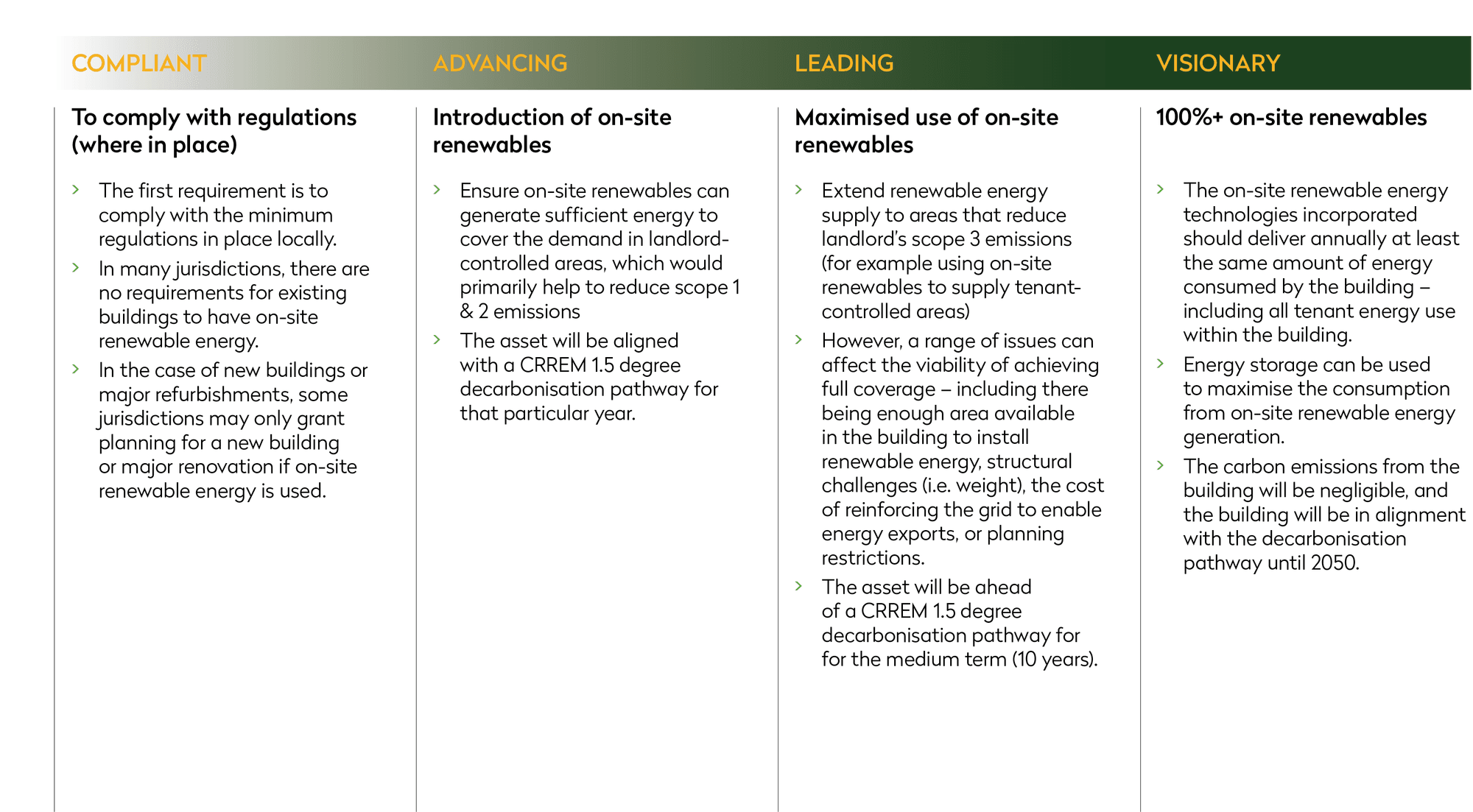
Our goal is always to maximise the use of on-site renewable energy generation. Most leading standards agree that this is a preferable alternative to off-site renewable energy generation, which comes with ongoing risks. Grid decarbonisation has clearly helped to reduce emissions; but there are still question marks over the long-term resilience of supply, and the traceability/ additionality of some renewable energy contracts.
Producing on-site renewable energy, by contrast, means a lower reliance on the grid. In some cases, the building may even be able to transfer surplus power back into the grid.
Of course, it’s often hard at the design stage to predict the level of on-site renewables (e.g. solar PVs) that will be necessary to meet the building’s requirements, because the needs of different tenants can vary greatly. Equally, it will sometimes be difficult to install enough on-site renewables to meet the expected energy demand from the building.
As such, most of these standards also allow for the use of third-party renewable contracts – if the supply sources are demonstrably additional, long-term, and fully traceable.
In the design phase, we would ideally apply whole life carbon analysis to quantify the relative benefits of these approaches, including their embodied carbon impact over the life of the building. Then during the in-use phase, we would disclose how much of the building’s energy is powered by on-site and/or other (fully traceable) renewables.
In our Spectrum, True Zero in Operation can only be claimed if the building is occupied, and actual energy consumption is equal to or less than the energy generated from on-site renewables (this energy generation must be verified over a period of 12 months).
However, assets that are not yet operational, but have reduced operational carbon as much as possible through design, may be designated as Designed for True Zero – if the modelled annual energy consumption from the building is equal to or less than the energy generated from on-site renewables.